modernc.org/sqlite with Go
Explore how to use modernc.org/sqlite with Go to handle SQLite's single-writer, multiple-reader model, optimize PRAGMA settings, and avoid CGo.
What would you do when you need an external service for your cloud application? Which one would you choose that is capable of handling lots of data? Could GoLang be an option? These are the questions we wanted to find answers to in our article.
In our scenario, one of our applications needed an export-data-to-excel feature. Probably many of us faced a similar demand in the past. The idea was to get a batch of data, transform it, and dump it into an Excel spreadsheet.
The obvious solution is to implement this service as a timed one into your application. This method worked well with a small amount of data. However, once the dataset was large enough, the application crashed. Someone tried to export too much data at once, which resulted in a memory issue, which brought down the application.
Could we separate the service from the rest of the application? Where would you host such an app? Do you expand your current environment with another service? Do you set up a separate environment? Should it be serverless? Which technology should you use?
If you decide to go serverless with a service, the most crucial consideration will be the cost. AWS provides a popular hosting base, and costs are calculated by resource usage mostly.
It fundamentally means the lower your CPU/RAM usage and the execution time is, the less you pay for the same service. Choosing the right technology is critical to optimize your Lambda execution times. Of course, you can go the traditional way and opt for Java, Python, or Node. There is, however, another alternative.
GoLang advertises itself as a language built for the cloud. Does this claim stand? We wanted to learn what the actual resource usage would look like for this specific excel export use case we had.
We received a bunch of data in JSON format and had to dump that in an Excel spreadsheet. Our previous solution was in Java, and once the input data exceeded a given threshold, the application crashed.
Our investigations concluded that it was a memory issue. If we had thrown a bunch of RAM into the configuration or optimized the solution, we could have most likely avoided the application crash.
We did not want to do that, so we considered moving toward a serverless solution.
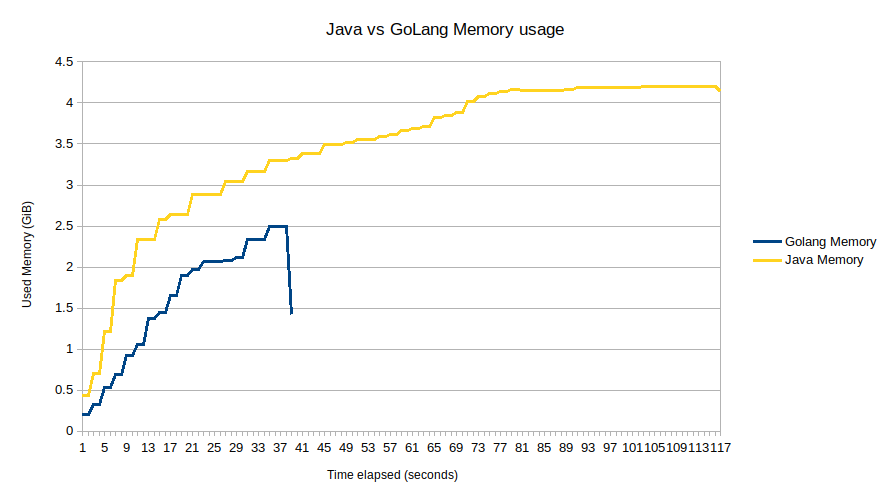
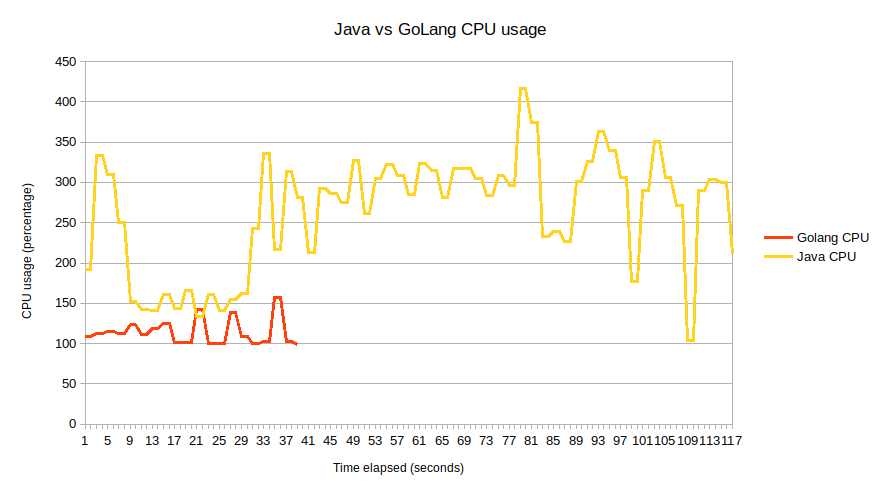
We generated an approximately 70Mb-large JSON file as an input (It is more than the maximum amount of data our service would ever receive) and wrote two sample pieces of code with roughly the same logic.
We wanted to make the playing ground somewhat even, so both services were Dockerized, and we measured the resource usage with docker stats.
As we see on the graphs, on average, the memory and CPU usage of GoLang was half of Java's.
Of course, the pattern of one programming language might not be the best for another. Sometimes language-native solutions work better for certain scenarios.
If your goal is to reduce your AWS Fargate or Lambda costs, we advise you to look at GoLang.
Explore how to use modernc.org/sqlite with Go to handle SQLite's single-writer, multiple-reader model, optimize PRAGMA settings, and avoid CGo.
By understanding the nuances of signal handling in containerized environments, we can prevent unexpected disruptions and maintain robust application performance.
React has become a dominant force in the world of web development, enabling developers to create highly interactive and dynamic user interfaces.